The Price of Knowledge
Last week, while I was doing some research on the ways companies are implementing child safety features (an essay I’ll publish in the future), I got blocked on the New York Times website, asking me to log in to my account. Otherwise known as “Subscribe now to keep reading”.
This got me wondering whether we need to add a new subscription to the pile every time we just want to access basic information. Even when we are just trying to keep ourselves informed.
I kept thinking (even arguing about it over family dinner) why knowledge isn’t just… free? I imagine it like a massive, open library, where anyone interested could just come right in and access what they were looking for, without the need to spend a single dime.
What even is information?
I’ve learned that some scientists call information the building block of reality. 1
Information is used everywhere at all times. Animals, for instance, need it for survival; they perceive their surroundings (see, hear, smell) and act accordingly. Humans, on the other hand, have something that is quite unique: culture. With it, we can access our predecessors’ experiences. We don’t have to retry things already known not to work, or rediscover paths that have already been mapped out. I see this as a giant, shared brain that we’ve been building across thousands of years. 2
This culturally based information is often called “culturally transmitted information”, which simply consists of sharing with others what we know. 3
How do we share all of this?
In prehistoric times, our ancestors would sit around a campfire and tell stories about their lives, both orally and visually. For example, cave paintings from that time show how our species has changed over time.
Later came the writing, which allowed for civilizations to develop faster. We started recording everything, from trade deals to even early philosophy.
Then with Gutenberg’s invention, the printing press, knowledge could spread widely and was no longer reserved for the elite or the church. Thanks to it, revolutions started; people gained a more profound understanding of how things actually were, rather than simply being told.
Already in the late 19th century, cinema allowed the transmission of visual narratives, which, not long after, entered everyone’s homes in the form of television. Now radio, film, and TV had the power to share information that carried culture across borders.
All this ease of sharing was accelerated by the rise of the internet. Now everyone could be a consumer and a creator at the same time (a bit like me sharing this); we now create and consume information at lightning speed. This is the Information Age. 4
Over our evolution, we changed the how of sharing things, while the why remained the same: to share our experiences and knowledge. 5
The Paywall Problem
Even though we live in an age where such powerful tools for sharing knowledge exist, our society’s capitalist brain comes into play, building artificial walls to force us to pay for the content we’re trying to consume.
Surely the image below is well known and experienced by you.
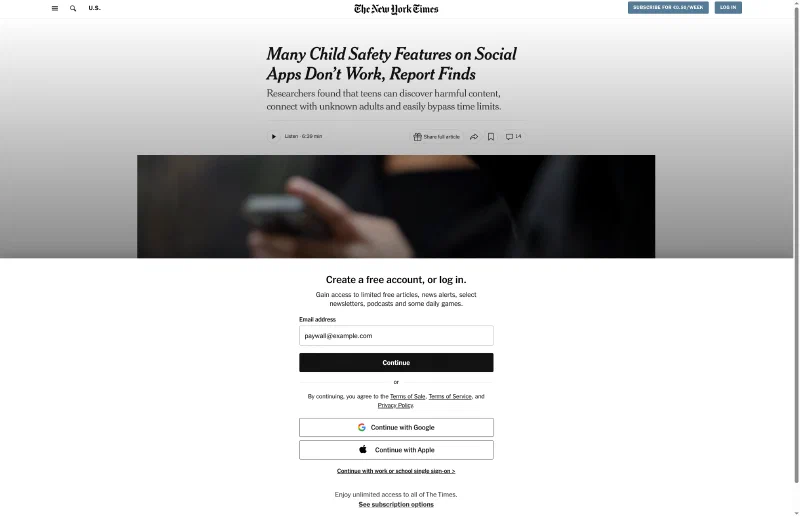
This is a way of limiting access to only those who can afford it. And it’s not just on news sites. We see it when trying to access books, scientific research, movies, and music.
The irony is that the UN’s Universal Declaration of Human Rights mentions that we all have the right to “seek, receive, and impart information and ideas” through any media. 6 This clearly shows that online platforms do not respect, or even care about, human rights; money is always what they aim for.
So, what are our options?
Before the digital era, whenever we wished to learn for free, we would just walk into a public library.
In the virtual realm, things get a bit messier when we talk about “owning”. Big platforms like Amazon, Netflix, or massive academic publishers love trapping us in their ecosystems. Even when we hit “buy” on an ebook or a movie, we aren’t actually buying it. We are renting a license to access the media. This means that whenever the platform decides to remove it, we lose access to it permanently.
Fortunately, there are still some good guys trying to preserve our rights. Talking about the Internet Archive, which aims to build the ultimate digital library. They allow you to find books, magazines, movies, and music for free.
It’s also worth mentioning that, because copyright law is so strict, most accessible content is either pretty old or already in the public domain, but there are always hidden gems worth exploring.
But even they aren’t safe from this. A group of major publishers, Hachette, Penguin Random House, HarperCollins, and Wiley, sued the Internet Archive for lending scanned books one copy at a time, the same way a physical library has worked for over a century.
The Internet Archive lost the case; courts ruled it wasn’t “fair use”, and over 500,000 books were pulled from lending because of it. 7
This really shows that even a nonprofit, trying to bring libraries into a digital world, gets sued the moment it threatens a book’s earning potential. All with the intent to keep unpaid access as limited as possible.
If that’s the outcome for the good guys, imagine how little room is left for the rest of us.
Where I stand
If it were up to me, all human knowledge would just be open. No price tags, no gatekeepers.
But honestly, this sounds more like a utopia. Obviously an “everything-is-free” model is not even imaginable in the real world. Creators, authors, and researchers have to eat, too. They absolutely deserve to get paid for their hard work.
Note that I mention the creators, not the corporations selling their work. Which is, usually, not the ones the paywall is protecting.
These companies (publishers, streaming platforms, etc.) are the ones that get the largest cut of what we pay for. The actual authors only get a tiny portion. So it’s worth asking how much the creators actually get paid when a paywall emphasizes that it’s for the best of them.
This is the part that turns my frustration from “creators shouldn’t be paid” (they should) into “the wrong people are collecting the check”.
While at the same time, by locking the knowledge away, we are leaving the information to only some. People who can’t afford it get left behind. And since knowledge is created in this shared brain, by limiting others, we are limiting ourselves.
To me, access to information is just as essential as food and water. In fact, it’s the food our brains need.
A more realistic middle ground
While a 100% free model isn’t realistic, a hybrid model is way more reasonable.
I idealize this as a world where we can read or watch the content for free, and if we learn or really like it and get real value out of it, we’d support the creator by buying the physical copy, a premium digital version, or simply by donating.
I found this to be very much true this year when I had to study the book Security Engineering by Ross Anderson.
The author, Ross Anderson, decided to publish his entire textbook online as a free PDF. Anyone who wishes to read it can. If later, they decide to buy a copy, physical and digital copies are available for purchase from the publisher. The interesting part of this is that the author mentioned a significant increase in demand for the physical copy. Giving away the free digital version actually boosted sales.
It’s a massive win-win. Readers got access, and the author still got paid.
When content is just totally locked away
This method is, unfortunately, very rare. Most of the available content is locked behind strict paywalls. And trying to avoid them means breaking the law.
This might seem contradictory next to what I said earlier about creators deserving to get paid. But when a company only chases nothing but maximum profit, purchased items are actually just rented, and from one moment to another, that can be revoked.
It’s important to say I don’t lose respect for the creator; only for whoever’s charging me for something they don’t even let me truly own.
Since I can’t legally tell you to go break the law, I obviously won’t. I definitely wouldn’t recommend going on Reddit and searching for the r/piracy megathread, because you might accidentally stumble on tools that bypass these paywalls entirely.
And we wouldn’t want to upset the massive corporations demanding your credit card info, would we? (*wink)
Carpenter, S. (2025, December 2). The building block of reality: Information. Open Access Government. https://www.openaccessgovernment.org/the-building-block-of-reality-information/201918/ ↩︎
EXPeditions. (2025). What makes us human? Meet the World’s Best Minds. https://www.joinexpeditions.com/exps/1266-what-makes-us-human- ↩︎
McMahon, M. (2023). Cultural Transmission | EBSCO. EBSCO Information Services, Inc. | Www.Ebsco.Com. https://www.ebsco.com/research-starters/social-sciences-and-humanities/cultural-transmission ↩︎
Crouch, G. (2023, January 12). Cultural transmission in the digital age. Medium. https://gilescrouch.medium.com/cultural-transmission-in-the-digital-age-e916b62f0d31 ↩︎
Journalism University. (2024, January 4). The evolutionary journey of communication media: From tradition to digital convergence. Journalism & Mass Communication Hub. https://journalism.university/fundamentals-of-development-and-communication/evolution-communication-media-tradition-digital-convergence/ ↩︎
UN General Assembly. (1948). Universal declaration of human rights (Article 19). https://www.un.org/en/about-us/universal-declaration-of-human-rights ↩︎
Freeland, C. (2024, December 4). End of Hachette v. Internet Archive | Internet Archive Blogs. Archive.Org. https://blog.archive.org/2024/12/04/end-of-hachette-v-internet-archive/ ↩︎
Comments
No comments yet. Be the first to share your thoughts!